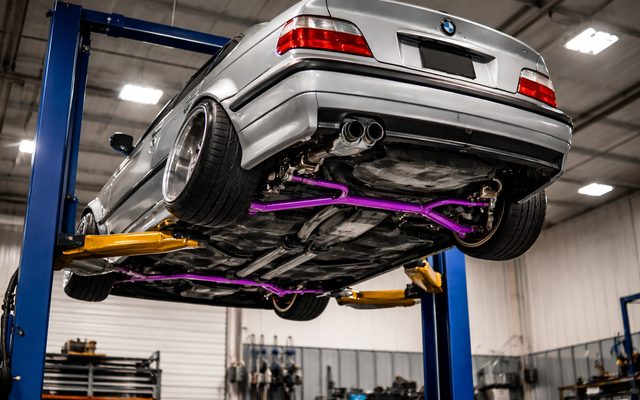
In the demanding realm of modern serious oversteer competition, success is far more than solely a function of raw torque or behind-the-wheel courage. Instead, it has evolved into a multifaceted engineering challenge which necessitates a meticulous fusion of choosing a inherently capable chassis, outfitting it with the most precise performance hardware, and, most essentially, comprehending its dynamic performance on the circuit through cutting-edge vehicle dynamics analysis tools. This comprehensive handbook will serve as your blueprint starting from the initial concept of a drift build right through to the final data-informed tweaks that turn a capable vehicle into a predictable winner. We will delve deep into the methodical process of chassis dynamics adjustment, demonstrating how a advanced drift tuning app like GripDial removes approximation and offers exceptional visibility into your car's actual behavior.
The bedrock of any great drift car is, undoubtedly, the platform itself. Certain cars have earned renowned standing within the international oversteer culture due to their built-in balance, robust build quality, and the immense range of performance parts available. Choosing the correct car is the primary and most important decision a driver will make. For instance, the BMW E36 is widely regarded as one of the best balanced cars for drifting of the modern era. Its excellent evenly distributed mass, alongside a rear-wheel-drive setup and robust straight-six engines, forms a car that is simultaneously forgiving for newcomers and extremely competitive in the hands of a expert pilot. The evolution of this philosophy, the E46 model BMW, builds upon these qualities with a increasingly refined frame, broader track for greater high-speed stability, and even increased lock straight from the OEM. A different dominant platform in the professional circuit is the C6 generation Corvette.
This muscle-derived performance car offers a distinctive set of advantages to the drifting world, including a lightweight alloy structure, a backwards-positioned drivetrain component that contributes to an perfect front-to-rear mass ratio, and the tremendous torque of a powerful LS-series V8 engine. This combination transforms it into an absolute monster on track, capable of starting and holding extended angles with apparently effortless use of acceleration. For those desiring exceptional performance per dollar, the Nissan Z33 rises above as a top-tier choice. It is delivered from the factory with a rigid platform, a decent factory limited-slip differential, and the free-revving VQ35DE engine that offers plenty of power and torque for mastering and progressing in the discipline. Its successor, the Nissan 370Z, brings more advancements in chassis stiffness, suspension design, and outright powerplant output, cementing its status as a popular pick among professional drivers. Further legendary vehicles that deserve mention include the lightweight Wankel-engined FC generation RX-7, the ever-present Nissan S13 240SX, the V8-powered Ford Mustang SN95, the modern BMW E90, and the tiny yet incredibly fun and teachable MX-5 Miata. Each of these chassis gives a distinct array of traits, complexities, and possibilities, but they all have in common the fundamental ingredients essential to become a serious drift machine.
However, selecting the correct chassis is just the beginning. To unlock the full performance of every of these vehicles, major modifications to the steering system and chassis control systems are utterly non-negotiable. This is where the realm of specialist tuning components comes into sharp focus. The one most game-changing improvement for a dedicated drift car is the installation of a drift-spec angle modification kit. These advanced systems, like those developed by specialist companies like specialist manufacturers, are created to significantly expand the chassis's available steering angle. A OEM street car is highly limited in how far its steering tires can rotate, a safety limitation for daily driving. In sliding, however, extreme countersteering is constantly necessary to manage and sustain a drift. An modification kit replaces the OEM hubs, tie rods, and sometimes suspension arms with pieces that allow the front tires to reach steering lock in excess of 70 or even 80 degs, versus a average OEM angle of around 40 to 50 degrees.
This vastly expanded lock gives the operator with significantly enhanced control during a drift, allowing it to be much more straightforward to begin a slide, maintain it through a extended bend, and transition smoothly from one direction to the opposite. The contrast in drivability is truly transformative. Combined with a correctly selected modification is the just as essential modification to the vehicle's spring and damper setup. Off-the-shelf or even premium road dampers are generally not engineered for the unique and brutal needs of drifting. A drift-spec pair of coilovers is crucial. These specific coilovers feature custom piston tuning and spring strength that are optimized for the violent load shifting that is typical of drifting. When a pilot initiates a drift, the chassis's inertia is transferred rapidly to the outside of the turn. Proper drift-spec coilovers control this movement in a predictable way, permitting the vehicle to settle rapidly and providing the driver accurate feel through the steering wheel and seat. They furthermore provide precise setting of stance, damping rate, and cross-weight, which are all integral parts of dialing in the chassis's behavior to a particular track or competition approach. As a system, a top-tier drift angle kit and a properly selected system of drift-spec coilovers form the core hardware base upon which all later optimization is based.
Once the essential parts is fitted, the next critical phase in the development is the meticulous setting of the chassis's wheel angles. This is the realm of car suspension tuning, a methodology that can appear intimidating to the beginner but is, in reality, the key to transforming a set of fast parts into a unified and predictable machine. The most discussed element of tuning for drifting is undoubtedly negative camber. Wheel camber is the angle of the wheel in relation to the perfectly straight plane when viewed from the forward of the chassis. If the top of the wheel is leaning towards the chassis, this is referred to as negative camber. In oversteer driving, an inward tilt on the front axle wheels is generally applied and is seen as critical. The purpose is fundamentally related to vehicle dynamics.
When a vehicle is cornering at extreme sideways angles, the frame leans towards the outside of the turn. This body roll makes the outside front tire to reduce its best contact patch with the asphalt. By adding an inward tilt, the tire is pre-leaned to counteract this tilt. As the car tilts into the turn, the outside front tire gains a better contact patch on the track, increasing its bite at the critical time when it is absolutely essential for control. Commonly, front angles for a dedicated sliding vehicle range from approximately -3 degrees to as extreme as -5 degrees or even greater, depending on the parameters of the chassis configuration, tire type, and operator style. The back wheels also use negative camber, but the angles are generally more modest and subtler than the front axle. Excessive inward lean at the back can cause the vehicle to excessively tail-happy and challenging to control on acceleration input, as it reduces the usable grip area of the powered tires during linear acceleration. Thus, rear angles are commonly in the range of -1 degree to -3 degrees, finding a precise equilibrium between offering sufficient lateral traction to assist in initiating and sustaining the slide while simultaneously preserving usable hook-up for acceleration the turn. camber angle is only one part of the larger tuning puzzle, which additionally includes toe angle, caster angle, and bump steer adjustment.
Toe describes the orientation of the wheels as seen from a bird's-eye view. Toe-in means the leading edges of the tires are closer together than the trailing edges, while outward toe means the opposite. For oversteer, a slight amount of front axle toe-out is commonly employed to improve the turn-in steering reaction, making the car feel more nimble and eager to start a slide. Rear toe angle is typically set to neutral or a very small amount of positive toe to foster stability under power. caster angle is the longitudinal or rearward angle of the suspension pivot when viewed from the side of the car. Increased positive caster enhances self-centering and high-speed solidity, and it additionally increases negative camber gain during steering, which is very useful. Setting these settings is a complex interaction where a adjustment to a single setting can and often will influence the other settings. The conventional approach for tuning a car's suspension geometry for competition has historically been a labor-intensive affair of experimentation and feeling. A tuner or crew would introduce a modification based on a hunch, test the vehicle on track, depend on the pilot's subjective car suspension tuning sensation and comments, and then apply a further tweak. This cycle would repeat again and again until the chassis felt "good" or the allotted track period ran out. This system is not only exceptionally wasteful in terms of man-hours and costs, but it is furthermore inherently imprecise.
Pilot feel is a notoriously inconsistent metric, influenced by countless elements such as exhaustion, varying track conditions, weather, and merely the mindset of the driver on that specific day. What feels "loose" on one run might feel "tight" on the following lap, resulting in confusing data and ineffective tweaks. This long-standing limitation in car suspension tuning is exactly where state-of-the-art technology has intervened to revolutionize the methodology.
The rise and application of advanced suspension tuning applications has introduced a completely new age for building and optimizing high-performance drift machines. These tools, represented by groundbreaking solutions like data acquisition tools, work by actively recording the actual physical behavior of the car as it is operated on the track. Unlike using personal impression, these tools gather measurable information on critical parameters such as suspension travel, corner velocities, lateral and longitudinal g-forces, lock position, and driver input position. This acquired data stream is then interpreted by sophisticated algorithms that can graph and analyze the metrics in a actionable format. For the very first time, tuners and teams can visualize specifically what the chassis is exhibiting at any given moment of a slide. This ability transforms the entire suspension tuning workflow. Imagine the particular task of dialing in the front camber for a particular vehicle. As an alternative to applying a change from -3 degrees to -3.5 degrees and then running several runs to try and "feel" a improvement, a vehicle dynamics tool can provide instant and irrefutable information. The tool can display in a chart how the tire's grip is performing during the key stages of a slide: the initial flick, sustain, and changing direction. It can show if the current angle is enabling the outside front tire to maintain maximum contact or if the tire is over-stressed on its external edge.
The software can subsequently suggest empirical recommendations for adjustment. Perhaps the information shows that the tire is even overloading its edge at -3.5 degrees of negative camber, suggesting suspension engineering that an increase to angle, say -4 degrees, might be beneficial. On the other hand, the information might reveal that the tire is not reaching heat or that the inner shoulder is wearing too quickly, which could point to that there is excessive negative camber and a small lessening back to -3.2 degrees would be more optimal. This degree of accuracy and practical analysis was completely impossible in the era of pure mechanical setup.
The effect of using a advanced drift telemetry system extends far beyond merely optimizing camber. It becomes an invaluable coilover setup tips that is tailored to your exact car. When setting the shock absorber clickers on your suspension, rather than depending on imprecise guidelines or replicating another car's numbers, you can employ the software to see how the chassis is reacting coilover setup tips in response to your changes. The application can graph the wheel movement trace over a run, highlighting if the coilovers are controlling the chassis motion effectively or if they are permitting the chassis to become unsettled excessively after a transition. It can assist in identifying problems like excessive compression or topping out, permitting you to introduce informed adjustments to spring preload, damping rates, or ground clearance. This methodology extends similarly to the complex task of car alignment tuning. Beyond camber, the software can provide insight into how modifications to toe and caster are influencing the vehicle's handling during specific phases of a slide. For example, it can allow you to find the optimal amount of front axle negative toe for your individual steering rack geometry and competition technique by measuring the response time of turn-in reaction and the predictability of the chassis at full lock. This turns the tool an exceptionally useful vehicle dynamics manual that is constantly updated by the actual behavior of your specific car on the tarmac. It shifts the complete project from a dark art into a methodical development exercise.
Furthermore, the value of a platform like data acquisition is not restricted to experienced engineers with large budgets. For the club-level driver, it acts as an powerful equalizer. It practically provides the builder with the insight of a full-time race engineer without requiring the corresponding cost. It accelerates the tuning process by providing clear answers to questions that would otherwise take seasons of experience to understand. A driver can learn how their individual car reacts to specific inputs, developing a more intuitive knowledge of suspension theory in the process. It additionally opens up professional suspension engineering principles, enabling every enthusiast with the ambition to optimize their machine to accomplish it in a efficient and successful fashion. This is especially significant in a discipline like oversteer competition, where tuning expertise has historically been a tightly held advantage among elite drivers. In the modern era, that knowledge can be in the garage of any motivated builder.
In the final analysis, the journey to building and tuning the ultimate high-performance drift machine is a comprehensive project that seamlessly combines time-honored mechanical wisdom with cutting-edge data technology. It starts with the strategic choice of a legendary platform, then built upon the integration of non-negotiable drift-spec parts like maximum-angle angle modification systems and properly specified performance coilovers. The journey then progresses into the precision stage of alignment optimization, where settings like negative camber, toe, and caster are meticulously set to complement the chassis's upgraded hardware and the driver's specific style. Finally, and what truly separates the modern approach from the past, is the use of a powerful suspension tuning application. This tool eliminates the guesswork and inefficiency of purely seat-of-the-pants adjustment by giving objective, actual telemetry on how the car is really behaving. It functions as an incredible engineering partner, a comprehensive coilover setup manual, and a comprehensive chassis development system. Together, this complete methodology guarantees that every aspect of the drift car—from the selection of the platform to the last click on the coilover—is optimized for peak success on the track. It represents the complete progression of the discipline of drifting, merging raw pilot talent with data-informed chassis dynamics to build the most effective machines attainable.